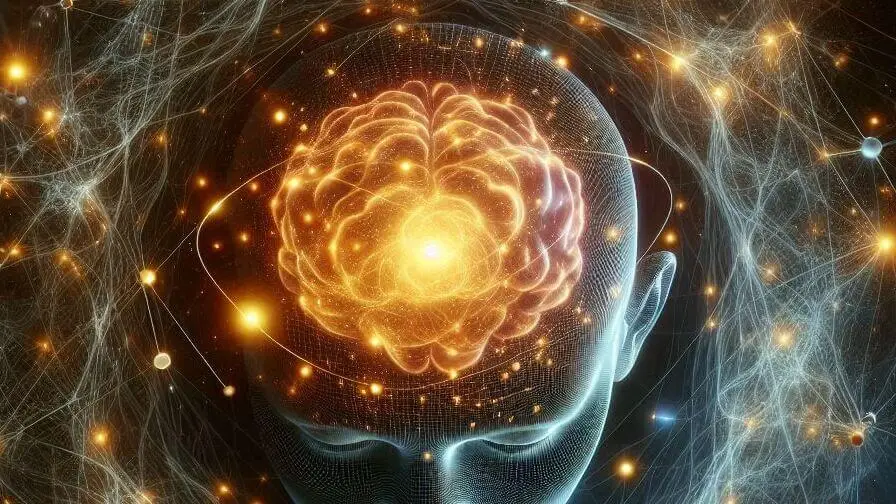
Exploring how quantum processes in the brain might shape our experiences
Exploring how quantum processes in the brain might shape our experiences
Deep down, your brain is an ensemble of the smallest bits of matter in the universe.
These subatomic particles don’t play by the rules of the everyday world. They obey quantum physics—the mind-bending theory that posits objects can exist in multiple states at once and entangled atoms can instantaneously interact across vast distances.
Some scientists speculate that the strange happenings in this microscopic realm may hold the key to understanding consciousness. But scant evidence has left the majority skeptical.
That includes Christof Koch, Ph.D., meritorious investigator at the Allen Institute. As he wrote in his recent book, Then I am myself the world, “the brain is wet and warm, hardly conducive to subtle quantum interactions.”
But despite his skepticism, Koch is collaborating with scientists at Google Quantum AI and universities worldwide to explore the role quantum mechanics might play in shaping consciousness. A paper published in Entropy offers their novel theory on the links between quantum mechanics and consciousness and details a series of experiments to test it.
Some of those experiments—like linking a human brain to a quantum processor—are currently impossible. But other studies are actively pursuing signs of quantum activity within the brain, with results expected within the next few years.
Koch, who has spent decades studying the link between the physical matter in our brains and our conscious minds, remains open to unexpected discoveries.
“Anything that isn’t ruled out by the laws of physics can be exploited by evolution,” Koch said. “Evolution is very clever and has had the entire planet to play with for 4.5 billion years, so it’s possible.”